Most cancer vaccine are investigated more as therapeutics than prophylactics and have been reviewed elsewhere 20 60 61. Production and Mechanism of Action.
 Schematic Representation Of Mrna Vaccines And Mechanism Of Antigen Download Scientific Diagram
Production and Mechanism of Action.
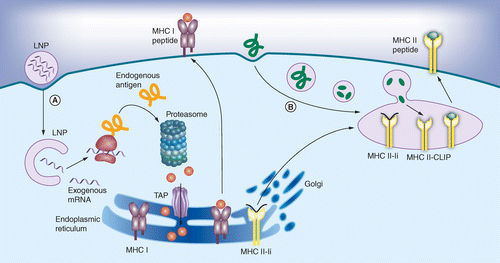
Mrna vaccine mechanism. The cell would then turn this mRNA into a viral protein. The present review summarizes the growing body of work defining the mechanisms of action of this exciting new vaccine technology that should allow rational approaches in the design of next generation mRNA vaccines. Bio-distribution of mRNA localization of antigen production role of.
The idea behind mRNA vaccines like the kind developed by Moderna and Pfizer for COVID-19 is to insert an mRNA from the virus into a cell. Could mRNA COVID-19 vaccines be dangerous in the long-term. Exogenous mRNA must penetrate the barrier of the lipid membrane in order to reach the cytoplasm to be translated to functional protein.
The cell engulfs the virus in a bubble and pulls it inside. An mRNA vaccine takes the mRNA or messenger RNA which is the instructions basically to yourselves protein-making machinery to make the antigen. Like other vaccines mRNA vaccines work by training the immune system to recognize a threat like a virus and begin producing antibodies to protect itself.
Next the cell displays the protein piece on its surface. DNA is not as fragile as RNA and the adenoviruss tough protein coat helps protect the. MRNA vaccines against infectious diseases could be developed as prophylactic or therapeutic.
COVID-19 mRNA vaccines are given in the upper arm muscle. These antigen-containing ingredients are prepared and grown outside the body. The Pfizer vaccine and the Moderna vaccine use synthetic mRNA that contains information about the coronaviruss signature spike protein.
MRNA Vaccines against COVID-19. SARS-CoV-2 the virus that causes COVID-19 coronavirus has a unique physical. Despite this the US.
Rather than giving you an inactivated virus particle. After the vaccine is injected into a persons arm the adenoviruses bump into cells and latch onto proteins on their surface. Mechanism of Action for.
Traditional vaccines stimulate an antibody response by injecting antigens an attenuated virus weakened or harmless virus or a recombinant antigen-encoding viral vector carrier virus engineered to have antigens citation needed into muscles. The vaccine doesnt contain enough genetic information to produce viral proteins. MRNA vaccines operate in a very different manner from a traditional vaccine.
MRNA uptake mechanisms seem to be cell type dependent and. The rapid and robust immunogenicity profile of the mRNA-1273 vaccine most likely results from an innovative structure-based vaccine antigen design 23 coupled with a potent lipid-nanoparticle. Once the instructions mRNA are inside the immune cells the cells use them to make the protein piece.
Mechanism for Action mRNA vaccines have strands of genetic material called mRNA inside a special coating. Governmentand two agencies in particular the NIH and Biomedical Advanced Research and Development Authority BARDA has invested heavily in the vaccines development. As previously described the production procedure to generate mRNA vaccines is entirely cell-free simple and rapid if compared to production of.
That coating protects the mRNA from enzymes in the body that would otherwise break it down. ModernaCOVID-19 Vaccine mRNA-1273 Pfizer BioNTechCOVID-19 Vaccine BNT-162b2 Acknowledgments and Permission The mRNA Vaccine Slide Set is a collaborative effort between the University of Washington Infectious Diseases Education and Assessment IDEA Program and Cognition Studio Inc. There is a race to get the public vaccinated so we are willing to take more risk.
It also helps the mRNA enter the dendritic cells and macrophages in the lymph node near the vaccination site. Production and Mechanism of Action. The vaccines essentially work by sneaking in instructions.
Two mRNA vaccines from Pfizer and Moderna are nearing final approval and both work by rewiring a genetic trigger. MRNA vaccines expressing antigen of infectious pathogen induce both strong and potent T cell and humoral immune responses 8 16 19. Just enough to trick.
After the protein piece is made the cell breaks down the instructions and gets rid of them. The Oxford-AstraZeneca vaccine for Covid-19 is more rugged than the mRNA vaccines from Pfizer and Moderna. MRNA Vaccines against COVID-19.
Adenovirus Vector Vaccines Against COVID-19. Pathophysiology and Clinical Findings. But while traditional vaccines often use.
A single viral protein would not be enough to cause the cell harm or the host to become sick. Modernas vaccine however works using a completely novel mechanism unlike any other vaccine currently approved anywhere in the world. Mechanism of action of mRNA-based vaccines.
An mRNA vaccine contains a synthetic version of the RNA that a virus uses to form proteins.

